FORTE 2.0 – bonsilage’s proven inoculant just got an upgrade!
bonsilage FORTE 2.0 is the next generation of an already high-performance silage inoculant designed to control hard-to-ensile forage fermentation and actively protect your silage against clostridia. Read more!


SMARTER STRAINS. STRONGER PROTECTION. FORTE 2.0!
Building upon a proven homofermentative blend formulation, bonsilage FORTE 2.0 maintains the same application rate, same ease-of-use and same purpose, while introducing two newly selected strains that take clostridia inhibition to the next level. FORTE 2.0 is not change for the sake of change. It is a targeted upgrade driven by science to deliver the best fermentation solution for hard-to-ensile forages.
Stronger Clostridia Control 
No matter the amount of preparation, some forages are just naturally hard to ensile. Grass and legume forages are designed and managed in ways that make fermenting and ensiling particularly difficult.
If you have been to a silage bunk or pile where butyric acid is present, you most likely remember the fishy, rancid smell that comes along with it. This is a characteristic of clostridial fermentation; bacteria that ferment carbohydrates, proteins and even lactic acid into acetic and butyric acid.
Butyric acid doesn’t only signify unpalatable silage, but a lack of nutrients as well. Between the potential for decreased animals’ intake and the decrease of carbohydrates, sugars and proteins, silage with butyric acid should be avoided at all costs.
In terms of acid tolerance, there are three types of Clostridia:
 Low acid tolerance (e.g. C. sporogenes & C. bifermentans)
Intermediate acid tolerance (e.g. C. butyricum, C. beijenrinckii)
High acid tolerance (e.g. C. tyrobutyricum)
This means that clostridia can be harmful to fermentation in numerous ways. To combat the potential of clostridia, a rapid decline in pH is the simple solution. However, due to the variety of clostridia groups cited above, it’s important that we have control over the acid production that leads to a pH drop and actively control clostridia growth. That’s where bonsilage FORTE 2.0 comes in.
A Familiar Silage Inoculant

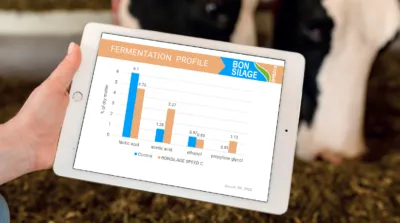
The proven bonsilage FORTE earned its reputation through a carefully designed combination of homolactic bacteria: Pediococcus acidilactici, Lactiplantibacillus plantarum, and Lactococcus lactis.
This combination was designed to rapidly dominate the silage microbiome and drive lactic acid fermentation, quickly reducing pH, while actively inhibiting clostridia growth.
With the coming of FORTE 2.0, this will all remain unchanged! But what really sets FORTE 2.0 apart are the two new strains of L. plantarum and Lc. lactis, selected through a rigorous internal research project, with unprecedented clostridia inhibition capabilities, resulting in an already familiar product with a significantly stronger defense against clostridial fermentation.
Same Purpose. Same Application. Stronger Protection!
FORTE 2.0 remains easy to apply:
Same handling and mixing procedures
Same dosage (2 g/ton of forage) and application rate (300,000 CFU/g of forage)
Same target forages (grass, alfalfa and small grain haylages)
FORTE 2.0 was developed with the goal of offering a stronger protection against clostridial fermentation while having a seamless transition of product use. Retaining the proven capabilities of bonsilage FORTE, while enhancing it with next-generation bacterial strains to meet the fermentation challenges of hard-to-ensile forages.
DOWNLOAD FORTE 2.0 NEWS